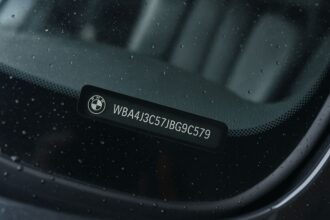
Decode Your VIN
Enter your vehicle's VIN code to discover all technical specifications. The VIN consists of 17 alphanumeric characters.
The 9th character of a VIN is not a random assignment.
It’s a calculated value derived from the other 16 characters using a formula NHTSA standardized under 49 CFR Part 565. Run the math wrong and you get a different result, which means a VIN that fails the check didn’t come from the factory.
This matters when you’re looking at a used car and want to know whether the VIN has been altered.
For the full position-by-position breakdown of the VIN, see how to read a VIN number.
The formula
Each character in a VIN is assigned a numeric value. Letters get mapped to numbers; digits keep their face value. Then each value is multiplied by a positional weight. The products are summed, and the sum is divided by 11.
The remainder is the check digit, except when the remainder is 10, in which case the check digit is “X.”
Transliteration table (letters to numbers):
| Letter | Value | Letter | Value |
|---|---|---|---|
| A | 1 | N | 5 |
| B | 2 | P | 7 |
| C | 3 | R | 9 |
| D | 4 | S | 2 |
| E | 5 | T | 3 |
| F | 6 | U | 4 |
| G | 7 | V | 5 |
| H | 8 | W | 6 |
| J | 1 | X | 7 |
| K | 2 | Y | 8 |
| L | 3 | Z | 9 |
| M | 4 |
Digits stay as-is. Letters I, O, and Q don’t appear in VINs at all, they’re excluded to avoid visual confusion with 1, 0, and 0.
Positional weights:
| Position | 1 | 2 | 3 | 4 | 5 | 6 | 7 | 8 | 9 | 10 | 11 | 12 | 13 | 14 | 15 | 16 | 17 |
|---|---|---|---|---|---|---|---|---|---|---|---|---|---|---|---|---|---|
| Weight | 8 | 7 | 6 | 5 | 4 | 3 | 2 | 10 | 0 | 9 | 8 | 7 | 6 | 5 | 4 | 3 | 2 |
Position 9 gets weight 0 because that’s the check digit itself, excluding it from its own calculation.
A worked example
VIN: 1HGCM82633A004352
| Pos | Char | Value | Weight | Product |
|---|---|---|---|---|
| 1 | 1 | 1 | 8 | 8 |
| 2 | H | 8 | 7 | 56 |
| 3 | G | 7 | 6 | 42 |
| 4 | C | 3 | 5 | 15 |
| 5 | M | 4 | 4 | 16 |
| 6 | 8 | 8 | 3 | 24 |
| 7 | 2 | 2 | 2 | 4 |
| 8 | 6 | 6 | 10 | 60 |
| 9 | 3 | — | 0 | 0 |
| 10 | 3 | 3 | 9 | 27 |
| 11 | A | 1 | 8 | 8 |
| 12 | 0 | 0 | 7 | 0 |
| 13 | 0 | 0 | 6 | 0 |
| 14 | 4 | 4 | 5 | 20 |
| 15 | 3 | 3 | 4 | 12 |
| 16 | 5 | 5 | 3 | 15 |
| 17 | 2 | 2 | 2 | 4 |
Sum: 311 ÷ 11 = 28 remainder 3
The check digit is 3, which matches position 9. This VIN is valid.
What a failed check digit actually means
A VIN that fails the check digit test was either:
- Mistyped (most common)
- From a pre-1981 vehicle (the formula wasn’t standardized until 1981, see classic car VIN decoding)
- From a non-US vehicle that doesn’t follow the NHTSA standard (some Canadian, European, and Asian manufacturers use different schemes for domestic-market vehicles)
- Deliberately altered
The last one is the concerning scenario. VIN tampering, changing characters to obscure a salvage title, a theft record, or a rollback, is a federal crime. But it happens. If a VIN fails the check digit and the car was supposedly built after 1981 for the US market, that’s a red flag worth following up on before you sign anything.
A check digit failure alone doesn’t confirm fraud. It’s a signal to look harder. Pull a full vehicle history report and compare the dashboard VIN against the door jamb, the firewall stamp, and the title. If any of those don’t match, walk away.
A second example: a VIN that fails
Take the same VIN as above but change one digit in the middle: 1HGCM82653A004352 (position 8 changed from 6 to 5). Running the same math against the new characters produces a different sum, and that sum no longer reduces to 3 at position 9. The VIN as typed is invalid, even though sixteen of its seventeen characters are identical to a real, valid VIN.
That is the entire point of the check digit. A single mistyped, misread, or deliberately altered character anywhere in positions 1 through 8 or 10 through 17 breaks the math. There is no way to change one character and have the check digit still agree, short of also recalculating and forging the check digit itself, which is a second, separate act of tampering.
Why the formula uses modulus 11
The check digit scheme was written into the US federal VIN standard, 49 CFR Part 565, when NHTSA and SAE adopted the 17-character VIN format industry-wide starting with the 1981 model year. The same weighted modulus-11 approach was carried into the international standard, ISO 3779, so the math works the same way on a VIN from any manufacturer that follows the standard.
Modulus 11 was chosen because it is a prime number larger than any single weight or transliterated letter value used in the calculation. That makes it very unlikely for two different 16-character combinations to produce the same check digit by coincidence, which is exactly what a checksum is supposed to prevent. The one awkward result is that the remainder can come out to 10, and a single digit cannot represent 10, so the standard designates the letter X to stand in for it at position 9 specifically.
Common ways people get it wrong
Most check digit failures have nothing to do with fraud. They come from:
- Handwritten transcription. A VIN copied by hand from a windshield onto a form is the single biggest source of errors, especially confusing 8 and B, or 5 and S.
- Scanned or photographed titles. Optical character recognition tools used by some dealerships and insurers occasionally misread a character, particularly on an older, worn, or low-contrast VIN plate.
- Copy-paste from a listing site. Some online marketplaces truncate or reformat VINs when displaying them, dropping a character without any visual indication.
- Transposed characters. Swapping two adjacent characters, a common typing slip, will almost always break the check digit even though every individual character is correct.
Before assuming the worst, re-read the physical VIN plate character by character and re-run the decode. It is far more common to have made a transcription error than to be looking at a genuinely tampered VIN.
Where to check the physical VIN yourself
If a decode does not match what you expect, compare the VIN in at least two physical locations before concluding anything is wrong: the dashboard and door jamb VIN locations, the title, and the registration. If you are checking a specific model, our per-model guides, for example the Honda Accord VIN decoder, show you exactly what a valid VIN and check digit look like for that vehicle.
If everything on the car matches but the VIN still will not decode, or if you are buying a used vehicle sight unseen, a recall check and a full vehicle history report will surface title, salvage, and ownership issues that a check digit alone cannot reveal.
FAQs
What is the check digit in a VIN?
It’s the 9th character, calculated from the other 16 using a weighted formula. It lets you verify that a VIN wasn’t mistyped or altered.
What if my VIN has an X in position 9?
X is valid. It represents a check value of 10, which can’t be expressed as a single digit, so NHTSA designated X as the placeholder.
Does every VIN have a valid check digit?
No. Pre-1981 vehicles weren’t subject to the standardized formula. Non-US-market vehicles may also use different formats. Use VinDecoderPlus to verify, the decoder flags check digit status automatically.
Can I calculate a VIN check digit by hand?
Yes, using the transliteration and weight tables above, though it takes a few minutes and one mistake in the arithmetic will give you a wrong answer. Decoding it automatically with a tool like VinDecoderPlus removes that risk.
Does a valid check digit prove the VIN is genuine?
No. It proves the 17 characters are internally consistent with each other, which rules out simple typos and most casual tampering. It does not confirm the vehicle’s history, title status, or that the VIN plate itself has not been swapped. For that, cross-reference the VIN against the title and a full vehicle history report.