Decode Your VIN
Enter your vehicle's VIN code to discover all technical specifications. The VIN consists of 17 alphanumeric characters.
A Vehicle Identification Number (VIN) is a 17-character code that identifies every car, truck, motorcycle, and trailer manufactured since 1981. Each position in the code carries a specific piece of information: the manufacturer, the country of origin, the model year, the engine, and a unique serial number.
Once you know what each character means, you can read a VIN the same way an automotive engineer or DMV inspector does.
This guide walks through every position of the VIN, explains what it tells you, and shows how to verify the code is genuine.
If you’d rather skip the manual decoding, you can enter your VIN here for an instant free lookup: the tool returns the same information in under five seconds.
Quick answer: what a VIN tells you
A 17-character VIN is divided into three sections:
– Positions 1–3: World Manufacturer Identifier (WMI): country and maker
– Positions 4–9: Vehicle Descriptor Section (VDS): model, body, engine, restraint system
– Positions 10–17: Vehicle Identifier Section (VIS): model year, plant, serial number
Position 9 is special: it is a check digit used to validate the VIN.
The three sections of a VIN
Every modern VIN follows the global ISO 3779 standard. NHTSA enforces it in the United States. The 17 characters always break down the same way.
Section 1: World Manufacturer Identifier (positions 1–3)
The first three characters tell you who built the vehicle and where.
– Position 1: Country or region of origin. `1`, `4`, `5` = USA. `2` = Canada. `3` = Mexico. `J` = Japan. `K` = South Korea. `W` = Germany. `S` = United Kingdom. `Y` = Sweden/Finland. `L` = China.
– Position 2: Manufacturer. Combined with position 1, this identifies the company. `1G` = General Motors USA. `JH` = Honda Japan. `WBA` = BMW.
– Position 3: Vehicle type or manufacturing division. For example, `1G1` is Chevrolet, while `1G6` is Cadillac.
Section 2: Vehicle Descriptor Section (positions 4–9)
These six characters describe the vehicle’s attributes. The exact meaning of each character is set by the manufacturer, but the categories are standardized:
– Positions 4–8: Model, body style, restraint system, transmission, and engine code. For example, in a Ford VIN, position 8 typically encodes the engine.
– Position 9: check digit: A mathematical value calculated from the other 16 characters. If you alter any character of a real VIN, position 9 will no longer match. This is the single best tool for spotting a forged or mistyped VIN.
Section 3: Vehicle Identifier Section (positions 10–17)
The last eight characters identify the specific vehicle.
– Position 10: model year. Letters and digits map to specific years: `A` = 1980 or 2010, `B` = 1981 or 2011, `Y` = 2000, `1` = 2001, `9` = 2009, `M` = 2021, `N` = 2022, `P` = 2023, `R` = 2024, `S` = 2025, `T` = 2026.
– Position 11: assembly plant. A single character identifying the factory.
– Positions 12–17: production serial number. A unique six-digit sequence assigned to that specific unit on the assembly line.
Position-by-position cheat sheet
| Position | Section | What it tells you |
| 1 | WMI | Country of origin |
| 2 | WMI | Manufacturer |
| 3 | WMI | Vehicle division / type |
| 4 | VDS | Model & body style |
| 5 | VDS | Restraint system / trim |
| 6 | VDS | Body type / cab style |
| 7 | VDS | Drive type / GVWR |
| 8 | VDS | Engine code |
| 9 | VDS | Check digit (validates the VIN) |
| 10 | VIS | Model year |
| 11 | VIS | Assembly plant |
| 12–17 | VIS | Serial number |
How to validate a VIN using the check digit
Position 9 is a calculated value. Decoding it manually proves the VIN hasn’t been altered.
Each character has a numerical value (letters convert per a fixed table — for example A=1, B=2, C=3, D=4, E=5, F=6, G=7, H=8, J=1, K=2, L=3, M=4, N=5, P=7, R=9, S=2, T=3, U=4, V=5, W=6, X=7, Y=8, Z=9; digits stay as themselves; the letters I, O, and Q are never used in a VIN).
Each position is multiplied by a fixed weight: 8, 7, 6, 5, 4, 3, 2, 10, 0, 9, 8, 7, 6, 5, 4, 3, 2 (position 9 has weight 0 because it is the check digit itself).
Sum the products, divide by 11, and the remainder is the check digit. If the remainder is 10, the check digit is the letter `X`. If the calculated value matches position 9 of the VIN, the VIN is mathematically valid.
The VinDecoderPlus tool runs this validation automatically every time you decode a VIN, so manual math isn’t required — but it is the gold-standard way to confirm a VIN is genuine.
Letters that never appear in a VIN
The letters I, O, and Q are excluded from every VIN to avoid confusion with the digits 1 and 0.
If you see any of these letters in what is supposed to be a 17-character VIN, the number has either been mistyped or is not a genuine VIN.
The remaining letters used are: A, B, C, D, E, F, G, H, J, K, L, M, N, P, R, S, T, U, V, W, X, Y, Z — plus all digits 0 through 9.
Worked example: decoding “1HGCM82633A123456“
Let’s read this VIN character by character.
– Position 1: `1` → United States
– Position 2: `H` → Honda
– Position 3: `G` → Honda Motor Company passenger car
– Position 4: `C` → Honda Accord (model code)
– Position 5: `M` → Body style
– Position 6: `8` → Restraint system / series
– Position 7: `2` → Trim / model variant
– Position 8: `6` → Engine code (3.0L V6 in this generation)
– Position 9: `3` → Check digit
– Position 10: `3` → 2003 model year
– Position 11: `A` → Marysville, Ohio plant
– Positions 12–17: `123456` → Serial number — the 123,456th unit off the line
Result: a 2003 Honda Accord with a 3.0L V6, built in Marysville, Ohio.
You can double check copying and pasting the VIN number 1HGCM82633A123456 inside the tool here above or in the homepage of VinDecoderPlus.com.
Where to find your VIN
The VIN is always present in at least four places on a vehicle. I
f they don’t match each other, the vehicle has likely been tampered with or rebuilt.
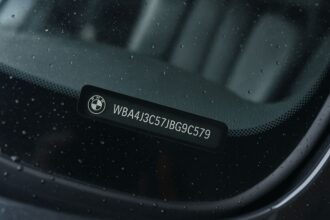
– The dashboard, visible through the windshield on the driver’s side
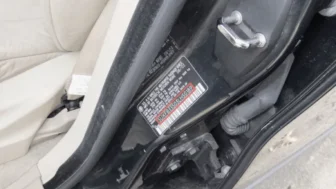
– Inside the driver’s-side door jamb, on a manufacturer sticker
– On the engine block or firewall in the engine bay
– On official paperwork: title, registration, and insurance card
For brand-specific VIN locations and photos, see our guide on where to find a VIN number on any.
When VIN reading really matters
Reading a VIN before you buy a used car protects you from at least four major problems:
1. Title fraud. If the VIN on the dashboard doesn’t match the title or the door jamb, walk away.
2. Hidden recalls. Roughly one in four used vehicles has at least one open recall, according to data published by the NHTSA. Decoding the VIN surfaces them instantly.
3. Mileage rollback. A decoded VIN paired with state inspection records can flag odometer tampering.
4. Salvage or flood titles. A full VIN decode reveals title brands the seller may not have disclosed.
A free decode takes five seconds: run yours now in this page before you sign anything.
Frequently asked questions
Why is my VIN only 11 characters?
Vehicles built before 1981 used non-standardized VINs that ranged from 11 to 17 characters.
If your VIN is shorter than 17 characters, your vehicle is likely pre-1981.
See our classic car VIN decoder guide for pre-1981 decoding rules.
Can two vehicles have the same VIN?
No. Under ISO 3779 and NHTSA standards, a manufacturer cannot reuse a VIN for at least 30 years. In practice, modern manufacturers never reuse VINs. If you find two vehicles sharing a VIN, one is fraudulent.
Does the VIN tell me the color of the car?
No. Color and most cosmetic options are not encoded in the VIN. Color is recorded on the manufacturer’s build sheet, which is a separate document linked to the VIN by serial number.
Is a VIN the same thing as a license plate?
No. A license plate is issued by a state or country and changes over a vehicle’s lifetime. A VIN is permanent and travels with the vehicle worldwide.
Can I decode a motorcycle or RV VIN the same way?
Yes. The 17-character format applies to all motor vehicles, including motorcycles, RVs, trailers over a certain weight, and even some heavy equipment. The position-by-position structure is identical.
Decode your VIN now
The VinDecoderPlus tool handles every step on this page automatically: country of origin, model year, engine code, plant, serial number, and check-digit validation and cross-references the result against the NHTSA recall database.
No sign-up. No credit card. Results in under five seconds.